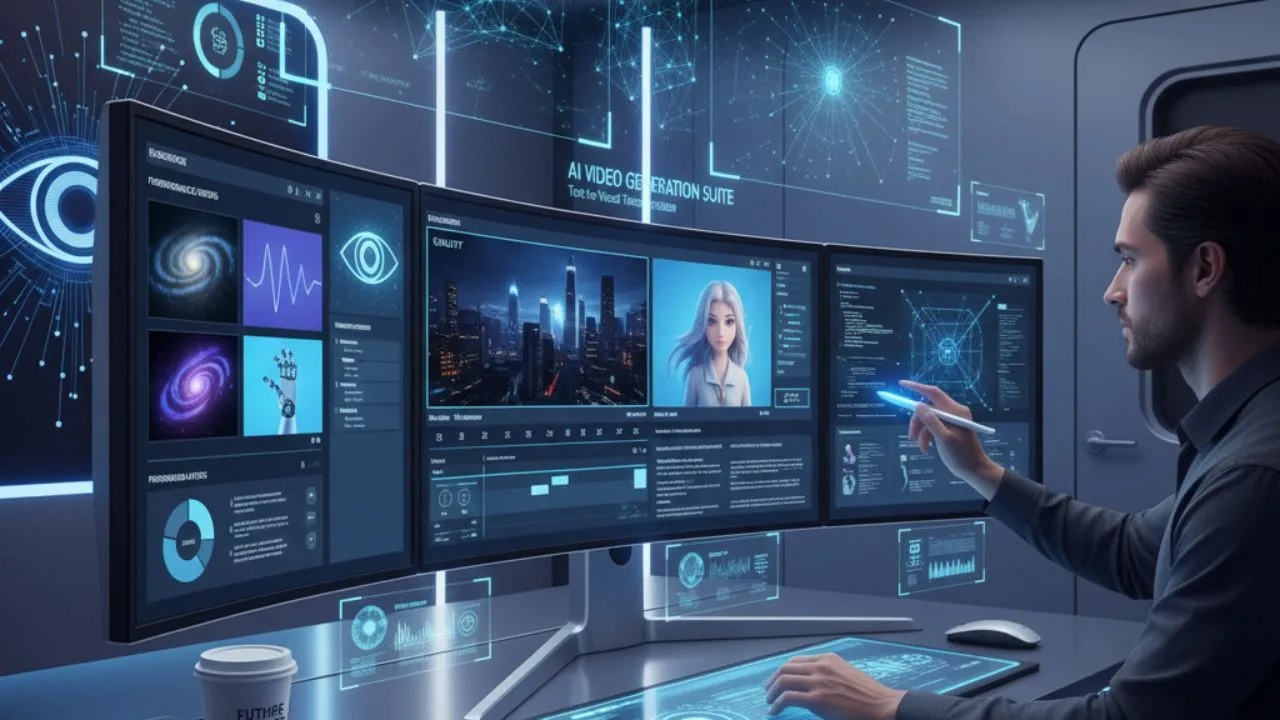
The Secret of the Best AI Text to Video Generators
The best ai text to video generator is rapidly catching up and changing the nature of content creation. It is now possible to create what used to take hours of shooting, editing, and post-production in a few keystrokes. Nonetheless, the success of these systems has a critical component, which is the accuracy of text interpretation. To what extent can the AI process the text input and transform it into a video that is visually engaging?

The magic of the AI actually reading your text prompts and interpreting them is the real magic. This does not only entail translating text into mere pictures and videos, but also making sure that every word, tone, and meaning is accurately reflected on screen. This interpretation will affect the quality of the final product, and that is why it is so important to select the most efficient AI text-to-video generator.
The Importance of Text Interpretation to the AI Videos
Any AI video generator relies on the interpretation of texts. Consider the case of telling a system to produce a video out of a complicated paragraph. The AI must deconstruct your words to create a video that fits the message in terms of meaning, context, and tone. This does not only mean a direct transfer of words to images, but also that the AI should comprehend the nuances.
An example is that, when your prompt contains humor and a particular tone of emotion, the most effective AI tools will understand it and reflect it accordingly. On the other hand, an underdeveloped generator may overlook those details, and a flat or incongruent output can be obtained. The most successful AI text-to-video generators will not translate words; they will make them come alive.
The Dilemma of Interpretation and Creativity
Creating text-based videos is puzzle-solving. On the one hand, the AI should remain faithful to the very essence of the text. On the other hand, it has to inject some innovation to make the end product visually appealing and cinematic. A fine line is walking because on the one hand, excessive creativity can make the video go too far away from the original meaning, and on the other hand, the video can be boring.
This difficulty is also enhanced by the fact that there are several aspects of the text that have to be interpreted. An account of a crowded street will mean that the AI will need to create particular types of images, such as pedestrians, cars, buildings, and streetlights. All these elements should interlock with each other to form a precise depiction of the text.
Enhancing Visual Quality: Not Only Words
In the case of video quality, there is more than just the text interpretation to consider. The smooth transition, high-definition images, and realistic-looking animation are essential elements of a video that can make the video seem professional. Luckily, the highest quality AI text-to-video generators have improved to provide high-quality images.
The systems usually have sophisticated algorithms that enhance the aesthetics of videos. The images are not just a by-product, whether it be refinement of the lighting, deepening of the textures, or the inclusion of realistic motion effects. They are as carefully made as the story of the video.
Take the example of a video that has been made by a text prompt that discusses a tropical beach. The AI will recreate not only the scene of the beach but also will deal with the details, i.e., the shining waves, the sun angle, or the sand structure. High-quality video will give the viewer the impression that he or she has been taken directly to the scene instead of viewing the digital version.
The Way AI Processes Complicated Descriptions
It is not easy to handle complex text prompts. An AI can easily understand a basic sentence, such as “A cat sits on a windowsill,” but what about more complex sentences? Suppose we have an invitation which says: “A dark, gloomy forest, on a stormy night, with the flickering light of a lantern making sickly shadows over the shaggy trees.”
In the case of the best AI systems, such a description is their strong point. The AI does not simply stick two store pictures of trees and a lantern. Rather, it filters the mood and the atmosphere expressed in the text, changing the light, background, and color shades to represent the mysterious and foreboding mood of the scene.
This touch-sense of the text is needed in order to make videos more than a collection of images, but rather immersive experiences, which engage the viewer in the story.
Minimizing the Distance Between Text and Video
The biggest part of generating AI-created videos that is the hardest to partake in is lessening the disparity between what we read and how it would appear on screen. This is especially relevant to abstract or emotional material. Such terms as joy or loneliness are difficult to visualize or imagine an AI, yet the most efficient text-to-video generators are becoming increasingly better at explaining them in the form of an engaging image.
As an example, when a person writes about the feeling of being joyful, AI may decide to show bright colors, panoramic shots, and cheerful music. In its turn, loneliness might be embodied by lonely characters, dull tones, and slowness of the movements. The visual language capability of the AI is what makes the difference between a highly developed and a primitive text-to-video generator.
The Contribution Made by the User Input to the Ultimate Video
Although AI text-to-video generators have evolved, they still leave space for the input provided by a user. Other generators are customizable, e.g., one may increase or decrease the speed of the video, the nature of the animation, or the exact tone of voice in the narration.
It is at this point between the user and the AI that you can be creative. Should the video not seem right or perhaps not as per your vision, you can adjust the input or the output. This is useful in allowing the user to have the desired video exactly as they want without having to follow a pre-created template.